
Lab waste as hidden treasure
Early results of phytolith analysis from Iberian prehistoric post-ORA pottery powder
Research Report by Ferrara, V., Von Allmen, R., González, M. F. S., Revert Francés, E.
Abstract:
Initially designed to explore cultural interactions between Phoenicians and local communities in the Iberian Peninsula during the 1st millennium BCE, the work presented in our paper expanded beyond traditional Organic Residue Analysis (ORA), by attempting phytoliths extraction from post-ORA pottery powder.
The aim was to assess whether such a methodological integration may enhance the understanding of past correlations between environments and material cultures in terms of pottery making and function, use of plant resources, food preparation, cultural practices, intercultural exchanges and networks.
Despite working with limited sample sizes (~1 g per sample), phytolith analysis successfully revealed distinct environmental signatures across different archeological contexts, illustrating the valuable contribution of plant biogenic silica studies within and beyond archeological research. Furthermore, an unexpected positive result in terms of hue detection during the laboratory procedure underscores the research practice as scientific discovery process.
By combining archeological, botanical, and chemical perspectives, our study showcases how phytoliths research can extend beyond traditional boundaries and complement established methodologies, reinforcing the necessity of interdisciplinary dialogue and multi-disciplinary approaches to archeology.
This research report was written in a collaboration between the Uppsala Archeobotanical Group (UAG) at Uppsala University, the Department of Human Geography at Stockholm University and CRC 1070 ResourceCultures, Institute of Pre- and Early History and Archaeology of the Middle Ages and Modern Times at the University of Tübingen.
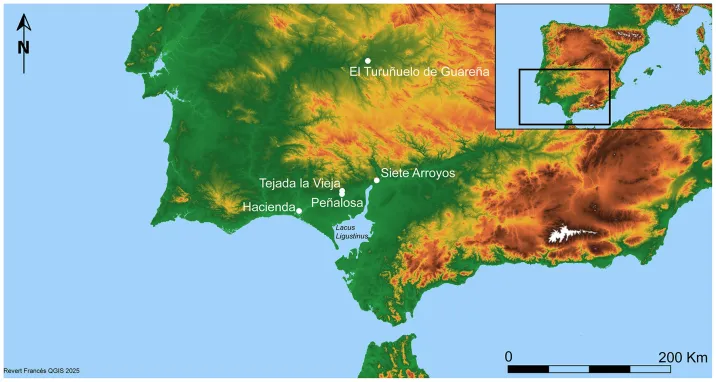
The featured image shows a map of the southwest of the Iberian Peninsula with the archeological sites named in the map. The drawing of the Lacus Ligustinus is based on the research of Oswaldo Arteaga (Arteaga and Roos, 1992; Arteaga et al., 2016).